Music teachers who organize tours occupy a strange middle ground between educator and tour manager. The trip has an academic purpose, a performance schedule, a set of families paying fees, a group of adolescents in an unfamiliar environment, and roughly two thousand dollars' worth of fragile equipment per student that has to arrive intact and in tune.
Ontario's music education community sustains a substantial calendar of these trips — MusicFest regional qualifiers, the Kiwanis festivals, the OMEA conference, exchange performances between schools, and the local circuit of retirement residences, community centres, and elementary feeder schools that senior ensembles visit throughout the year.
Instrument logistics are the single biggest way that a music trip differs from any other school trip, and they are consistently underestimated by anyone who has not run one.
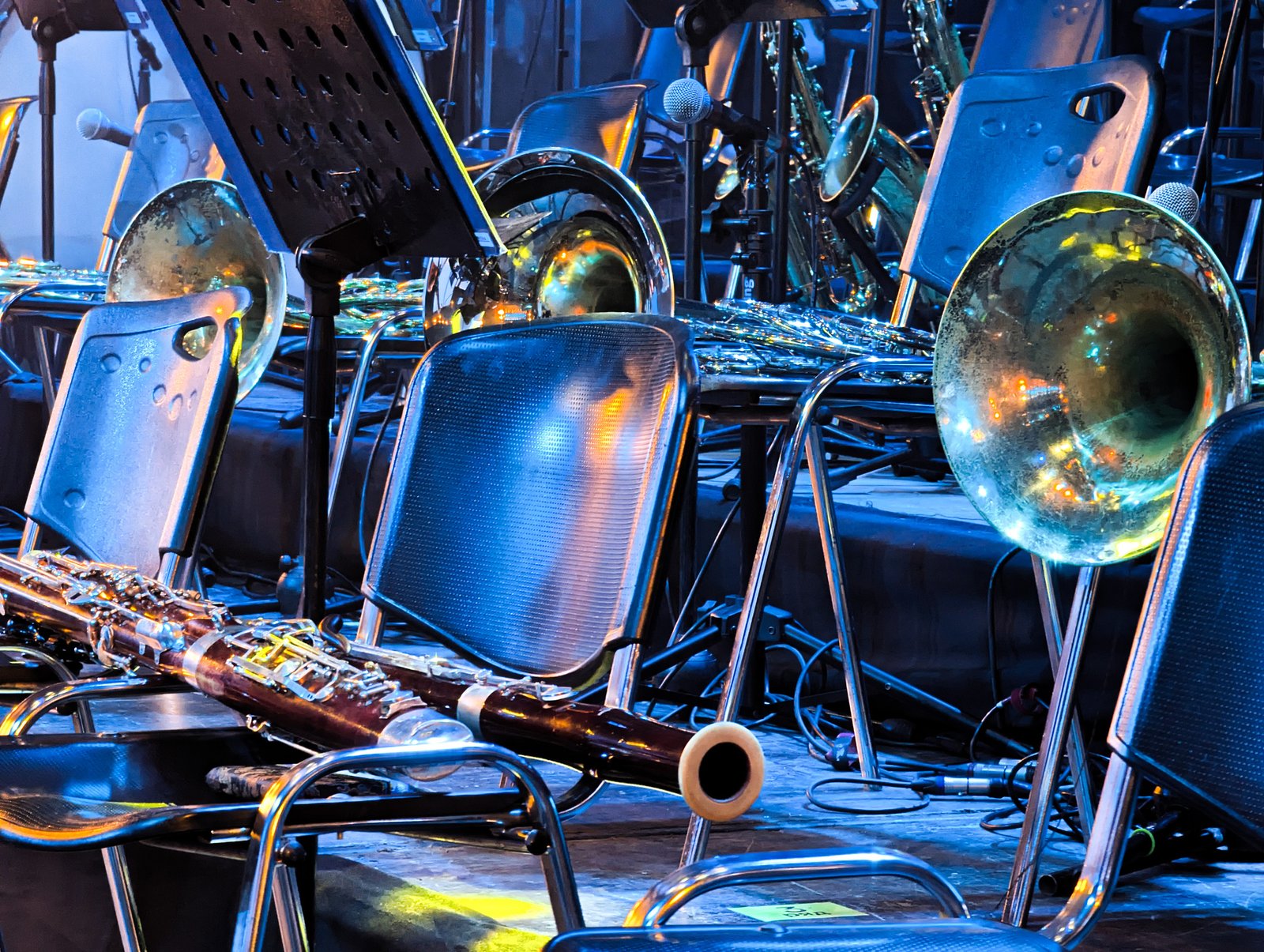
A concert band of sixty students travels with sixty cases ranging from a flute case the size of a hardcover book to a baritone saxophone case that requires two people to lift. Add the percussion section — timpani, a bass drum, a marimba if the repertoire calls for it, and a road case of small percussion — and the equipment volume approaches that of a small moving job.
School buses do not have luggage bays. Everything travels on the seats or in the aisle, which means students hold instruments on their laps for the duration, larger cases occupy seats that would otherwise carry students, and the aisle becomes an obstruction that is both uncomfortable and a genuine safety concern.
A motorcoach with underfloor luggage compartments resolves this. The bays accommodate the large cases and percussion equipment, students carry only what they want with them, and the vehicle arrives with the equipment secured rather than shifting around a passenger cabin for two hours.
Wooden instruments and brass instruments respond to temperature and humidity in ways that affect performance readiness. A cello that has spent ninety minutes in an unheated cargo space in February will need substantial time to acclimatize before it holds a tune. Woodwind pads, string tension, and brass tuning slides all shift with significant temperature change.
The luggage bays on a coach are not climate-controlled to cabin standard, but they are considerably more stable than an open-bed vehicle or a truck, and the difference is meaningful for instruments travelling in winter. Directors travelling with particularly sensitive instruments — a good violin, an expensive oboe — generally keep those in the cabin, which is straightforward on a coach and impossible when the cabin is already full of cases.
Performance schedules are unlike almost any other school trip constraint because they are genuinely immovable. A festival adjudication slot at 10:40 is at 10:40. An ensemble arriving at 10:55 does not perform.
That reality means a music tour's transportation planning has to account for warm-up time, instrument unloading and assembly, and a realistic buffer for traffic — not an optimistic one. For a festival appearance, most experienced directors build in ninety minutes between scheduled arrival and performance time. Percussion setup alone consumes a substantial portion of that.
Transnet Canada plans music trip routing around the performance time working backwards, including the loading window at the school, which is itself longer than most people estimate. Loading a full concert band with equipment takes between twenty-five and forty minutes depending on how organized the sectional leaders are.
Senior ensembles frequently travel for multi-day tours — Ottawa, Montreal, Stratford, or a circuit of performances across a region. These trips introduce additional considerations: overnight instrument security, hotel loading dock access, and the question of whether the coach stays with the group throughout or departs and returns.
For most multi-day music tours, keeping the coach with the group is the right answer. The instruments stay in a secured bay rather than being carried into and out of a hotel repeatedly, transitions between venues stay on schedule, and the group has a consistent base of operations. Transnet Canada arranges driver accommodation as part of multi-day quotes so that the vehicle remains available across the full tour.
Coach seating configurations support supervision better than most people assume. Chaperones distributed through the vehicle have sightlines along the full length of the cabin, and the raised driver position on a motorcoach means the aisle is visible. Directors typically position adult supervisors at the front, middle, and rear, with section leaders seated to distribute the older students among the younger ones.
Ontario school boards have specific requirements for chaperone ratios, driver qualifications, and carrier safety standards on board-sanctioned trips. Transnet Canada maintains the licensing, insurance, and CVOR standing that board procurement processes require, and can provide documentation directly to school administration during the approval process.
Festival season concentrates demand into a narrow window in the spring, and coaches with adequate luggage capacity book out early. Directors planning around a specific festival date should confirm transportation as soon as the performance slot is assigned. Contact Transnet Canada with your ensemble size, equipment inventory, and performance schedule, and we will match the vehicle to what the trip actually requires.