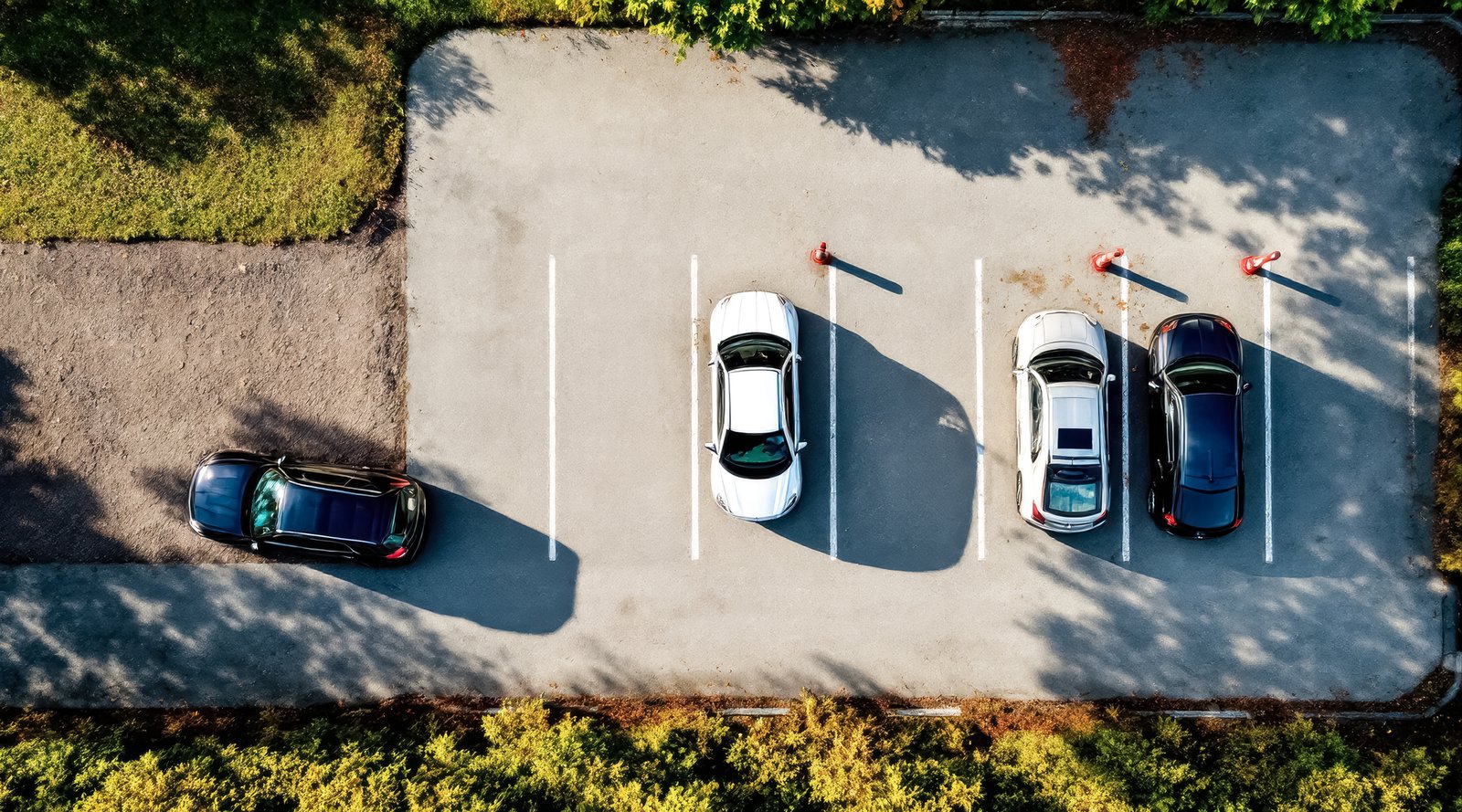
Every event organizer eventually meets the same wall. The venue holds four thousand people. The parking holds nine hundred cars. The arithmetic does not work, and no amount of optimism about carpooling closes a gap that size.
The standard solution — a shuttle loop between satellite parking and the venue entrance — is well understood in principle and frequently executed badly in practice. The difference between a shuttle operation that people barely notice and one that becomes the thing everyone complains about comes down to a handful of design decisions made weeks before the event.
The instinct is to find the closest available parking. The better criterion is the fastest round trip, which is not always the same thing.
A lot two kilometres away on a clear arterial with a signalized left turn produces a faster loop than a lot eight hundred metres away that requires crossing congested event traffic. The loop time — the full cycle from the lot to the venue, unload, return, and load — is what determines how many vehicles you need and how long people wait.
Suitable satellite locations are usually shopping centres with weekend surplus capacity, office parks empty on the event day, school lots, fairgrounds, and municipal facilities. All require permission arranged in advance, and most will want proof of insurance and a clear statement of hours.
The arithmetic is straightforward once you have the inputs. Take the number of passengers to move, divide by the peak arrival window in minutes, and you have a required throughput. Then take the loop time and the vehicle capacity to determine how many passengers one vehicle moves per hour. Divide the first by the second.
Where organizers go wrong is in the arrival window. People do not arrive evenly across three hours. They arrive in a spike, typically in the forty-five minutes before the event start, and the shuttle has to be sized for the spike rather than the average. A system sized for average demand will produce a queue of four hundred people at the satellite lot half an hour before doors.
The departure is worse. Everyone leaves at once. A venue emptying four thousand people in twenty minutes creates a departure demand that no reasonable shuttle fleet can absorb instantly, which is why the return operation needs both more vehicles and clear communication about expected wait times.
The single biggest determinant of loop efficiency is how fast vehicles load and unload. A coach that takes six minutes to load at a badly designed pickup point has added twelve minutes to every round trip, which can mean the difference between needing four vehicles and needing six.
Good loading design means a marshalled queue rather than a crowd, a clearly marked boarding position, staff directing people onto the vehicle rather than leaving them to figure it out, and enough curb space that a second vehicle can pull in behind the first and begin loading immediately.
Where space permits, running two loading positions in parallel roughly doubles throughput at no additional vehicle cost.
Attendees who do not know the shuttle exists will drive to the venue, discover the lot is full, and create exactly the congestion the shuttle was designed to prevent.
Communication has to happen before the day — in the ticket confirmation, on the event website, in the reminder email — and it has to be specific about where to park rather than vague about shuttles being available. On the day, signage on the approach roads directing traffic to the satellite lot before drivers reach the venue is what actually redirects behaviour.
At the lot and at the venue, signage should state the shuttle frequency and the operating hours, including the time of the last return trip. Attendees who miss the final shuttle because nobody told them when it was become a problem for the organizer at eleven at night.
A shuttle system that is not accessible has effectively removed parking access for attendees with mobility limitations. Either the shuttle fleet includes lift-equipped vehicles or the venue retains accessible parking on site with a clear route to it.
The on-site accessible parking approach is usually simpler for the organizer and better for the attendee, and it should be communicated as clearly as the general shuttle information.
Drivers drive. They cannot also manage a queue, answer questions, and count passengers. A shuttle operation of any scale needs event staff at both ends — at minimum one person at the satellite lot managing the queue and one at the venue managing the return line.
Someone also needs to be in radio or phone contact with the drivers and empowered to make decisions — hold a vehicle, add a run, shift a loading position. Transnet Canada assigns a point of contact for multi-vehicle event operations so the organizer has one number rather than four.
The useful conversation happens early, when the satellite lot is still a choice rather than a constraint. Bring expected attendance, the venue's on-site capacity, the event schedule, and any candidate lots you have identified. Transnet Canada will model the loop time, size the fleet, and give you a cost that reflects the operation your event actually needs. Contact us well ahead of the date — multi-vehicle event bookings require more lead time than a single charter.