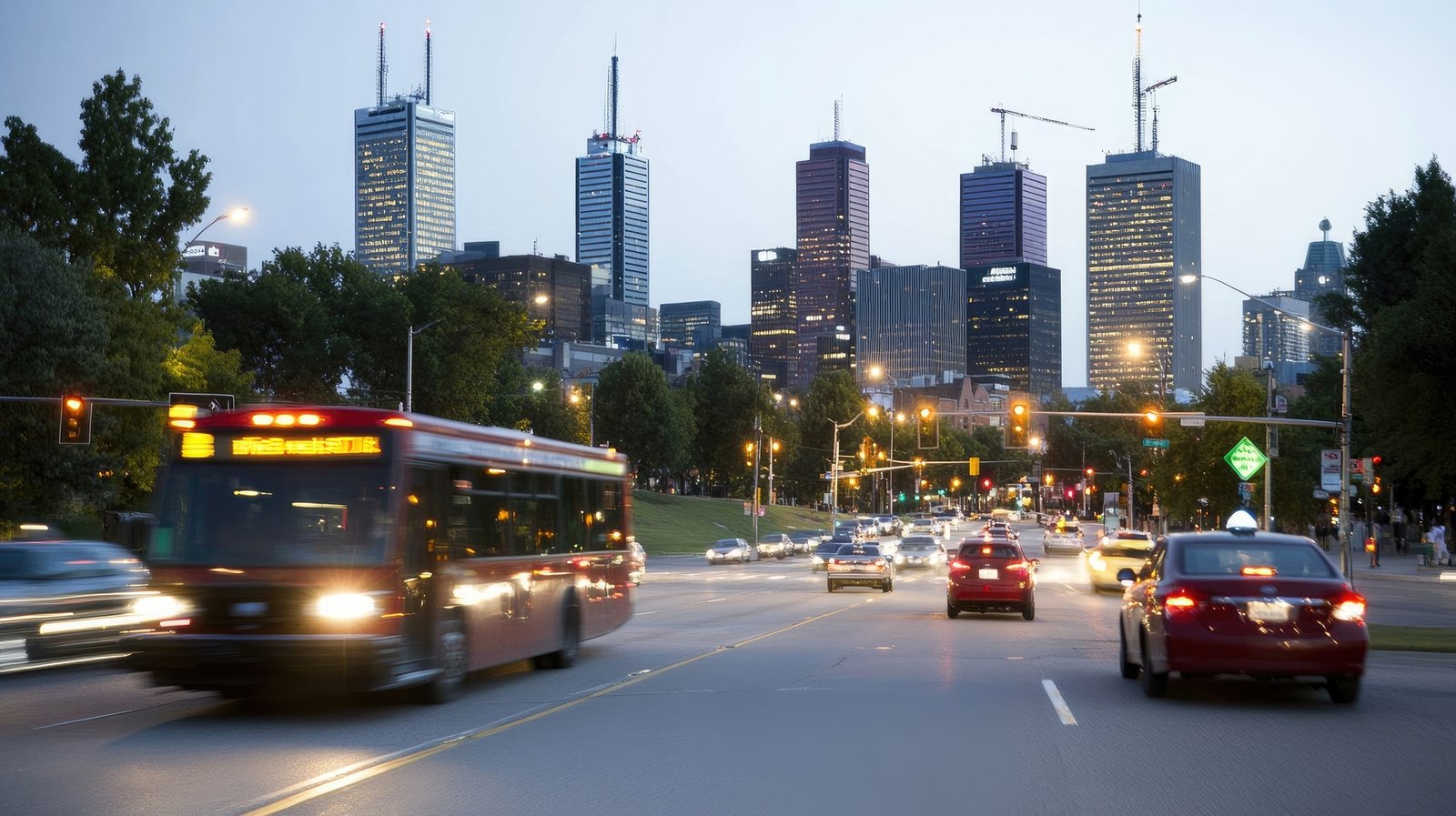
Group organizers planning a downtown Toronto departure usually choose the pickup point the same way they would choose a meeting spot for lunch — somewhere central, somewhere everyone knows, somewhere near a subway station. Then a fifty-foot motorcoach tries to execute that plan on a Tuesday morning and the limitations become apparent.
Downtown Toronto is a difficult environment for large vehicles. Streetcar tracks, dedicated transit lanes, construction hoarding, restricted turns, low bridges, one-way streets, and rush-hour stopping prohibitions combine into a set of constraints that most people are simply not aware of because they have never had to be.
A full-size coach needs roughly fifteen metres of clear curb to pull in and out safely, plus a lane it can rejoin without blocking traffic through a signal cycle. Downtown, that combination is genuinely scarce.
Rush-hour stopping and standing prohibitions apply on most major downtown arterials during peak periods, and they are enforced. A coach idling on Bay Street at eight-thirty in the morning is not going to be treated as a temporary inconvenience. Streetcar routes add a further restriction — a bus stopped in a streetcar lane blocks transit service and will be moved along quickly.
The result is that a nominally central pickup point may be one of the worst possible choices, while a location two blocks away with a proper loading area works perfectly.
The characteristics that matter are straightforward once they are named. A good downtown pickup location has a wide curb lane or a designated loading zone. It sits on a street without streetcar tracks, or on a section where the tracks are not in the curb lane. It is outside peak-period stopping restrictions, or the pickup is scheduled outside those hours. It allows the coach to approach and depart without a prohibited turn. And it gives the group a place to wait that is off the sidewalk flow — a plaza, a building forecourt, a wide sidewalk.
Hotel forecourts are frequently the best option downtown, and many hotels will permit a coach to use their driveway for a scheduled group pickup if arrangements are made in advance. Office towers with loading areas often work similarly. University campuses have designated bus areas. Convention facilities are purpose-built for it.
Certain downtown areas are simply better suited to coach operations than others. The Front Street corridor near Union Station has established coach activity and space that accommodates it, though it requires attention to timing. The area around the Metro Toronto Convention Centre is designed for large vehicle movements. Exhibition Place has extensive bus infrastructure. The Harbourfront and Queens Quay area has wider roadways and designated tour bus areas, though construction has intermittently affected it.
Areas that consistently cause difficulty include the core financial district streets during business hours, the Entertainment District on weekend evenings, Kensington Market and the surrounding narrow streets, and any block where active construction has narrowed the roadway.
A motorcoach stands roughly 3.8 metres tall. This rules out most underground parking structures entirely and matters at a handful of specific locations across the city where rail underpasses have restricted clearance.
Organizers planning a hotel pickup should confirm that the hotel's entrance canopy has adequate clearance — several downtown hotels have covered driveways that accommodate cars and shuttle vans but not full-size coaches. This is a five-minute phone call that prevents a genuinely awkward morning.
Once the location is settled, the group needs to be able to find it. An address is often insufficient downtown, where a building may occupy a full block and have entrances on three streets.
The best instructions name a visible landmark, specify which side of the street, and give the nearest intersection. Sending a photograph of the actual pickup spot to the group in advance is a small effort that eliminates a category of confusion entirely. Providing the driver's contact number, or the organizer's, gives latecomers a way to resolve their own problem.
Groups distributed across the city sometimes want several pickup stops. This works, within limits. Each additional stop adds time — realistically ten to fifteen minutes including approach, loading, and departure — and each one is a further opportunity for a delay to compound.
Two or three well-chosen points along a logical route work well. Six scattered points across the GTA turn a departure into a two-hour tour of the region before the trip has begun. Where a group is genuinely dispersed, a single central point with clear transit directions often serves everyone better.
Transnet Canada drivers operate in downtown Toronto continuously and know which locations work, which have changed because of construction, and where the practical alternatives are. When an organizer proposes a pickup point, we will say plainly if there is a better option nearby and explain why. Contact us with your group's location and departure time and we will settle the pickup logistics before they become a problem on the day.